The platform
An operational intelligence workspace, built for honest evidence.
The software designed to support an engagement: discovery, evidence, workflow maps, comparisons, baselines, approved pilots and reports, in one place. It is designed so that what is known, what is assumed and what is still unknown are never confused.
It is designed for supported engagements and is not presented as a mature self-service product. The screenshots on this page are real captures of the workspace using a fictional demonstration company.
What it does
Eight modules, one record of the work
Operational discovery
Company intake where every answer is marked known, unknown, hypothesis or verified. Interview and shadowing sessions follow structured prompts.
Evidence and assumptions
Each observation records its source — operator said, directly observed, system record or analyst inference — along with sensitivity and consent.
Workflow maps
An editable step list with actors, systems, time estimates and branches, drawn as a diagram. Only a reviewer can mark a map validated.
Intervention lab
Options compared side by side: process change, deterministic software, AI assist, AI with approval, and no change. A transparent scoring rubric, no black-box score.
KPI baselines
Measures with units and direction, recorded per period with sample size and source. Missing values stay missing; corrections are new records, not edits.
Pilot approvals
Draft, proposed, approved, running, review, scaled or stopped. A sensitive pilot cannot be approved by the person who proposed it.
Reports and playbooks
Versioned reports assembled from the records, with every line labelled by status. Playbooks only from a validated workflow with a measured pilot.
Portfolio visibility
Coverage, evidence health and pilot outcomes across the companies a person is allowed to see — never raw records from one company shown under another.
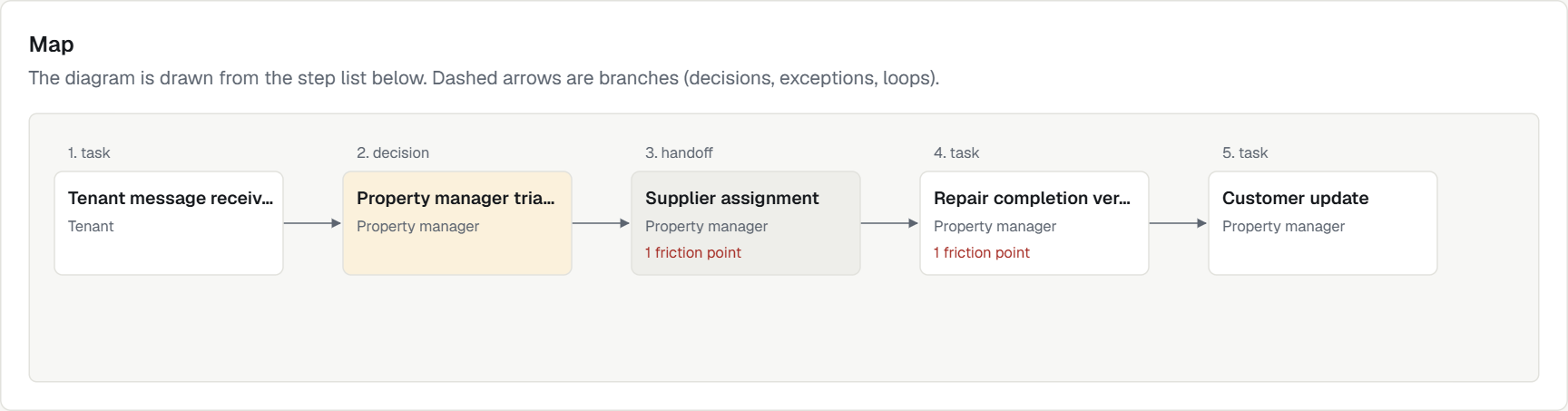
Workflow maps
The process as it really runs
Steps, actors, systems, time estimates and branches, drawn from an editable list. A map starts as a working hypothesis and is marked validated only by a reviewer.
Evidence and friction
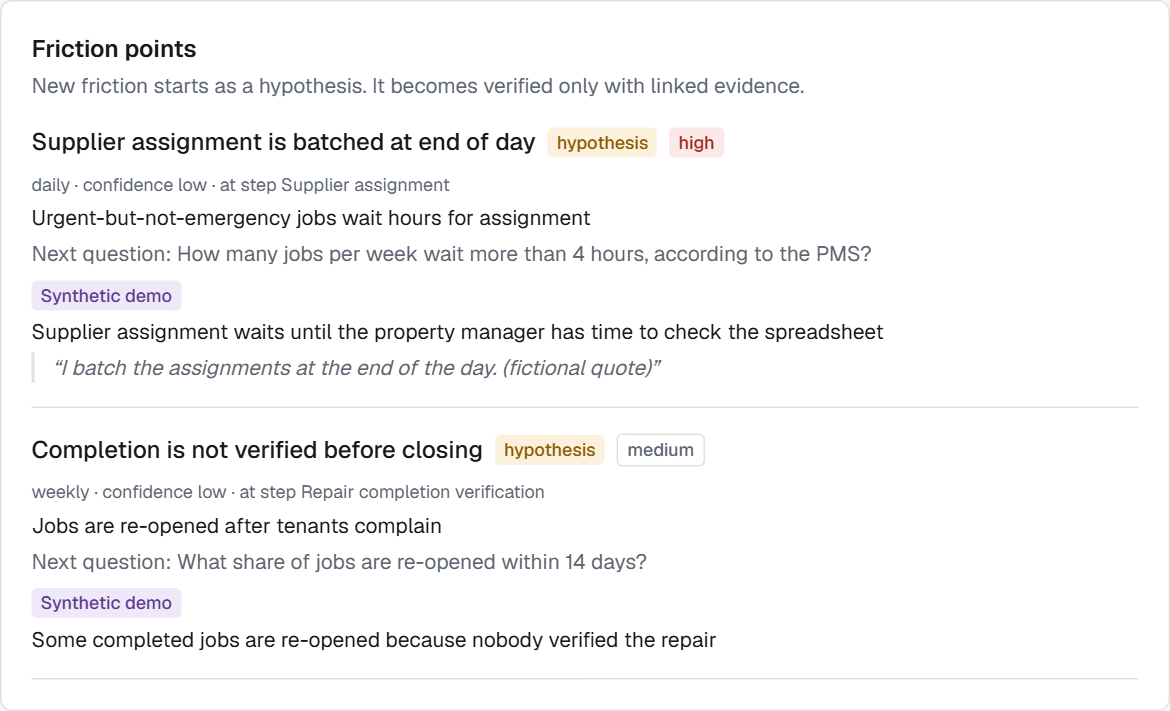
Every claim says how we know it
Friction starts as a hypothesis and becomes verified only with linked evidence. Each observation records whether an operator said it, it was observed directly, it came from a system record or it is an analyst's inference.
Intervention lab
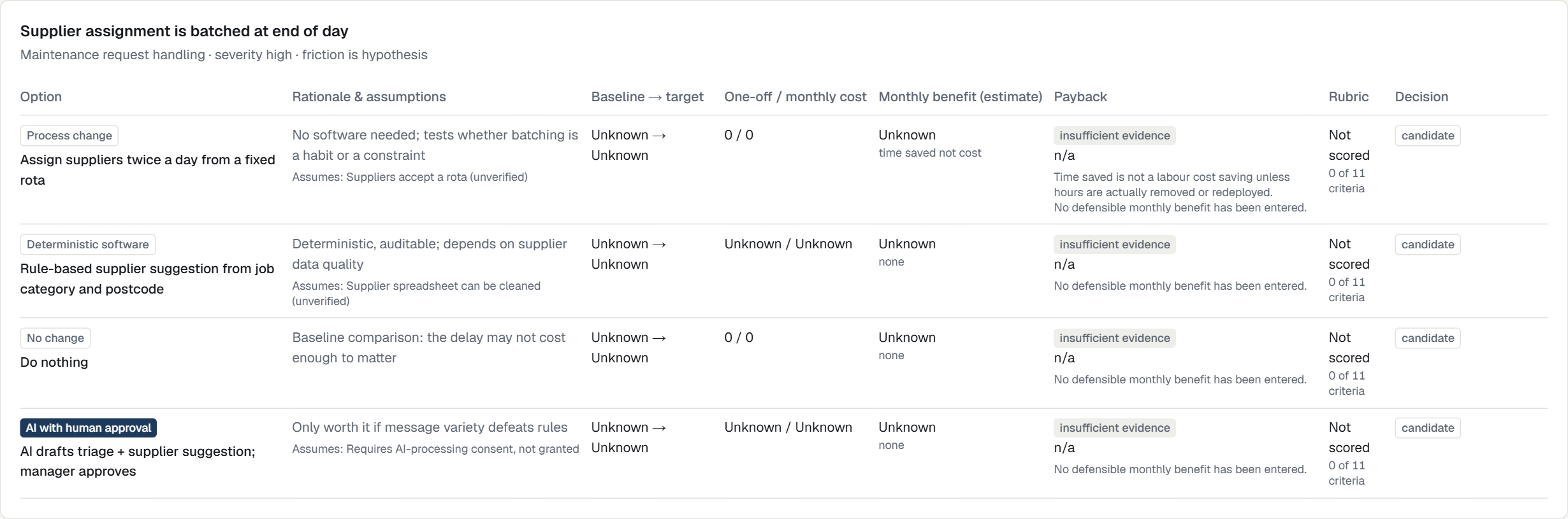
AI competes with simpler options
Each friction point gets several options: a process change, deterministic software, AI assistance, AI with human approval, and no change. Costs and benefits are entered with their basis; when evidence is missing the comparison says so instead of inventing a payback.
KPI baselines
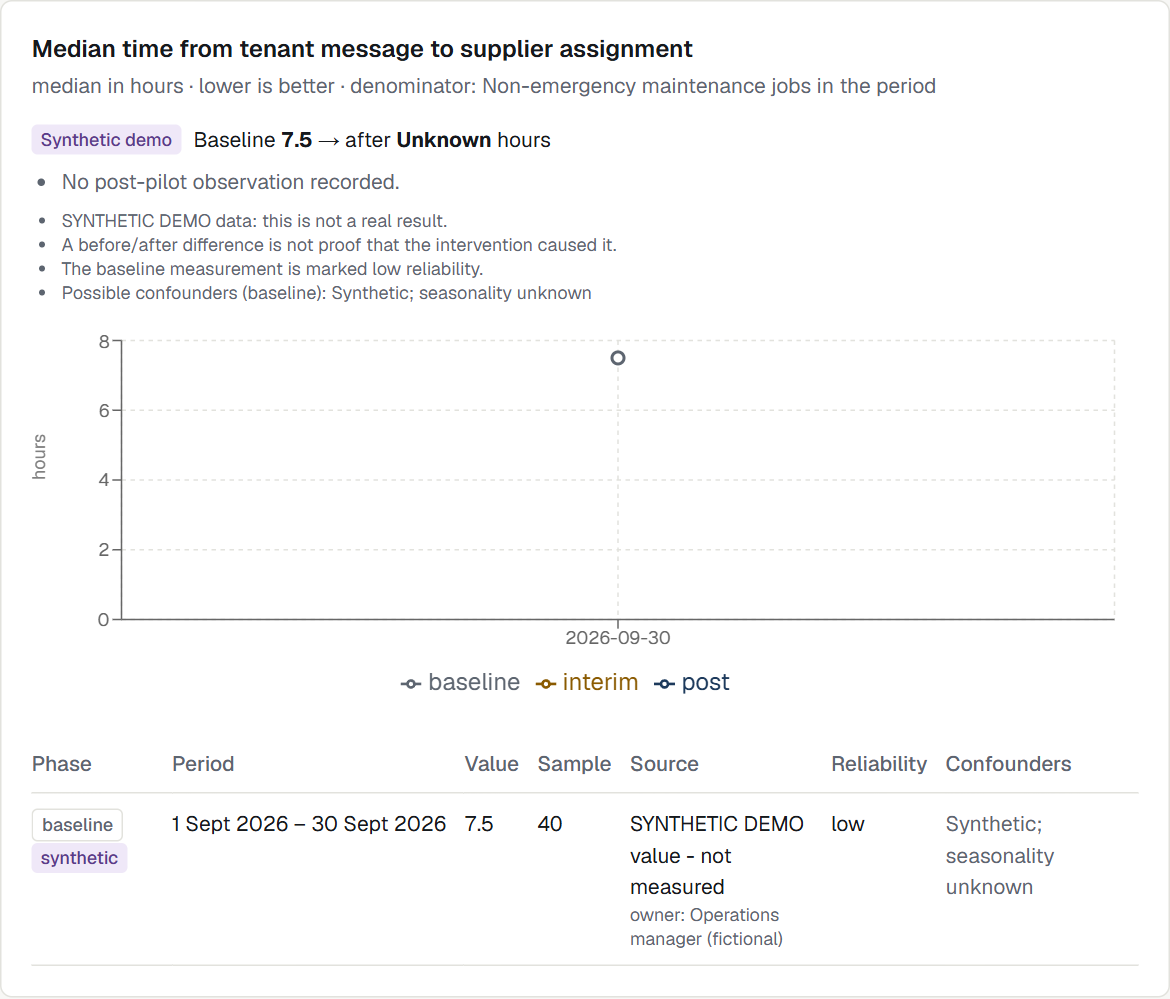
A baseline before any change
Measures have a unit, a direction and a denominator. Each observation records its period, sample size, source and reliability. Missing values stay missing, and corrections are new records rather than silent edits.
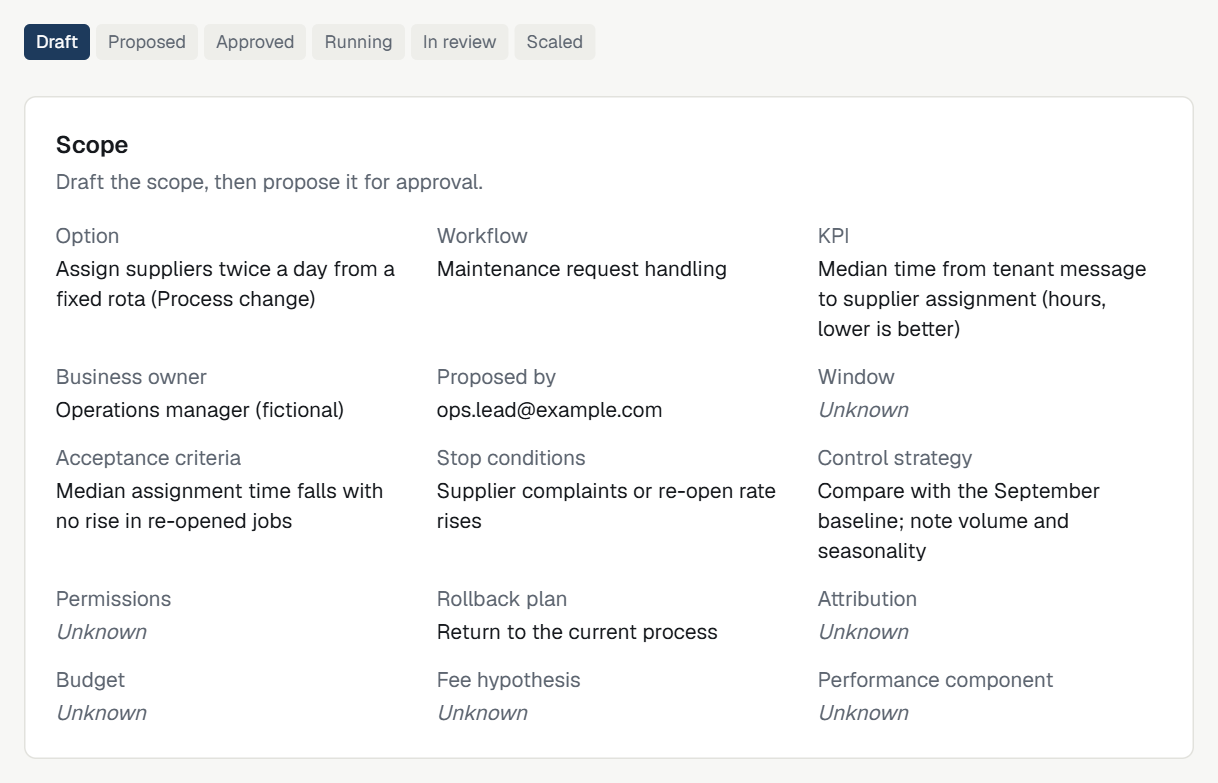
Pilot approvals
Changes are scoped and approved
A pilot moves through draft, proposed, approved, running and review before it can be scaled or stopped. It carries acceptance criteria, stop conditions and a rollback plan. For sensitive pilots the approver cannot be the person who proposed it — enforced in the database, not just the interface.
Reports and playbooks
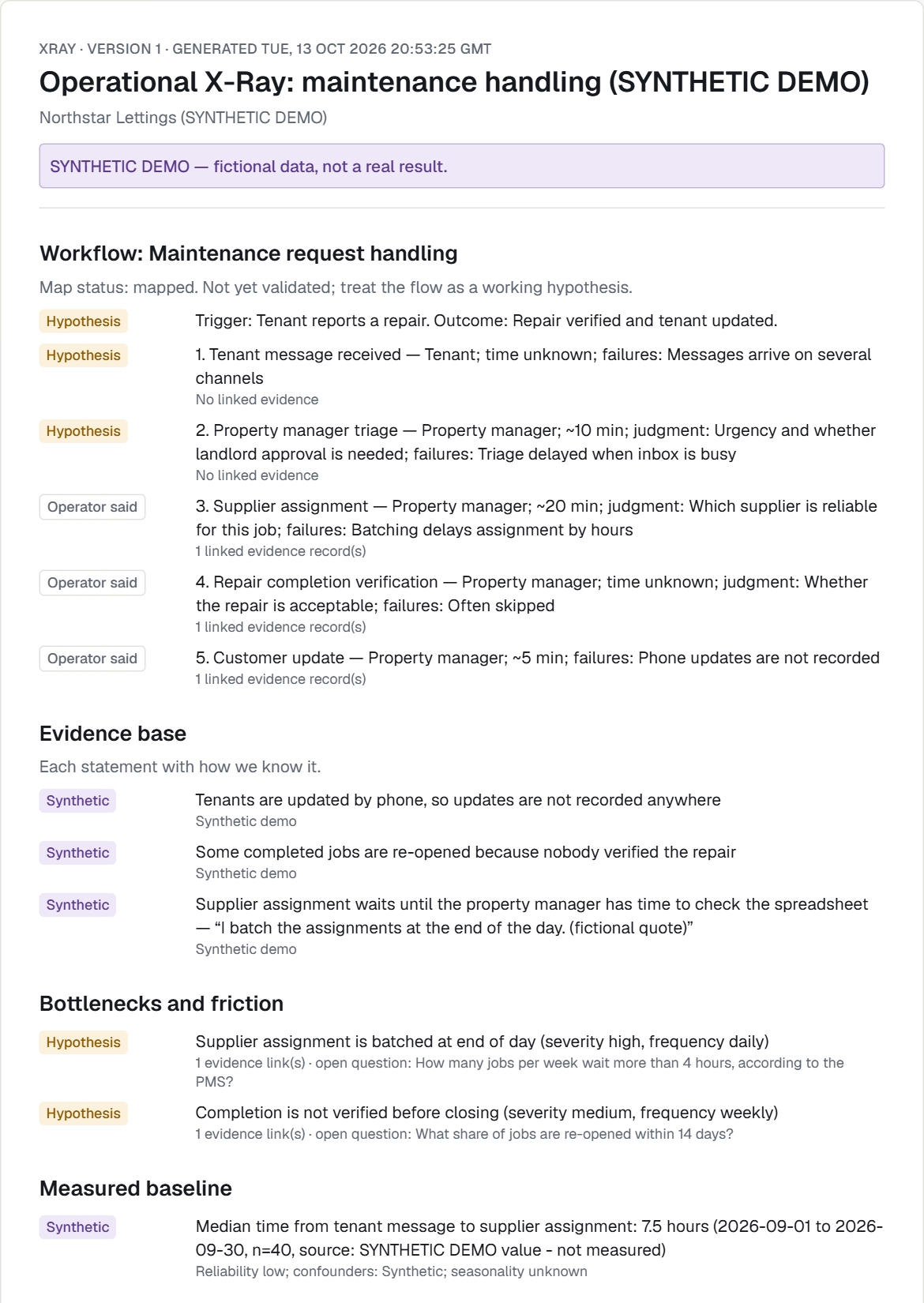
Reports built from the records
Reports are assembled from the underlying records and versioned, with every line labelled by status. A playbook can only be created from a validated workflow with a measured pilot, and it is applied elsewhere as a checklist, not an assumption.
By design
What the platform deliberately does
- Separates each client company's records; people only see the companies they have been given access to.
- Tracks consent per company and per purpose: observation, storage, AI processing and publication.
- Records decisions — approvals, stops, reversals — with a note, in an audit trail users cannot edit.
- Exports through the same access rules, and logs every export.
And does not
What it is not
- Records how work happens in your systems. The adapter inventory does not connect to external systems today.
- Not an autonomous agent. Optional AI assistance only suggests; people decide and approve.
- Not sold as a self-serve product with a price list. It is designed to support an engagement.
- Not a source of guaranteed savings. It reports what the evidence supports, including when that is little.
See your own workflow in it.
The platform supports a proposed engagement, starting with one workflow. Tell us which one you would like to understand.