Property management: maintenance coordination
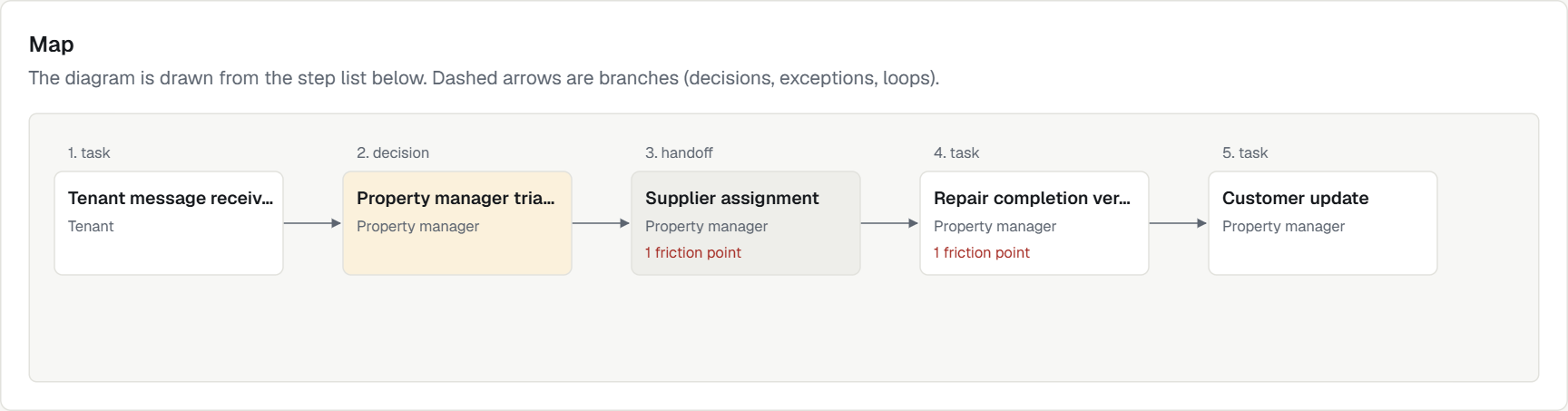
A tenant reports a repair by phone, email or portal. A property manager triages it, finds a supplier, chases completion and updates the tenant.
Operational intelligence for service businesses
Ampassador helps service businesses find workflow bottlenecks, compare practical fixes and measure what changes. Hands-on discovery, supported by operational intelligence software.
Early-stage platform. The approach is being developed for validation with operating teams.
One workflow, one X-Ray
Example
The problem
Service businesses run on handoffs, judgment calls and exceptions. The work happens across inboxes, spreadsheets and people's memory — so when something slows down, nobody can say exactly where, or what it costs.
Requests sit until someone has time to triage them, and nobody sees the queue.
Information is retyped between people and systems, and details go missing.
Decisions wait for one person, often informally, with no record of why.
The unusual cases take most of the time, but the process was designed for the usual ones.
Each team knows its part. No one can say where the time actually goes.
New tools get added on top, and the old friction stays underneath.
Buying another tool rarely fixes this. Adding AI on top of a process nobody has mapped usually makes it faster at going wrong. The first step is to see the work clearly.
The method
Every engagement follows the same disciplined loop. Nothing is changed before it is understood, and nothing is scaled before it is measured.
Where to start
An Operational X-Ray is a focused study of one workflow in your business: how it really runs today, where time and quality are lost, what it costs, and which improvements are worth testing first.
The platform
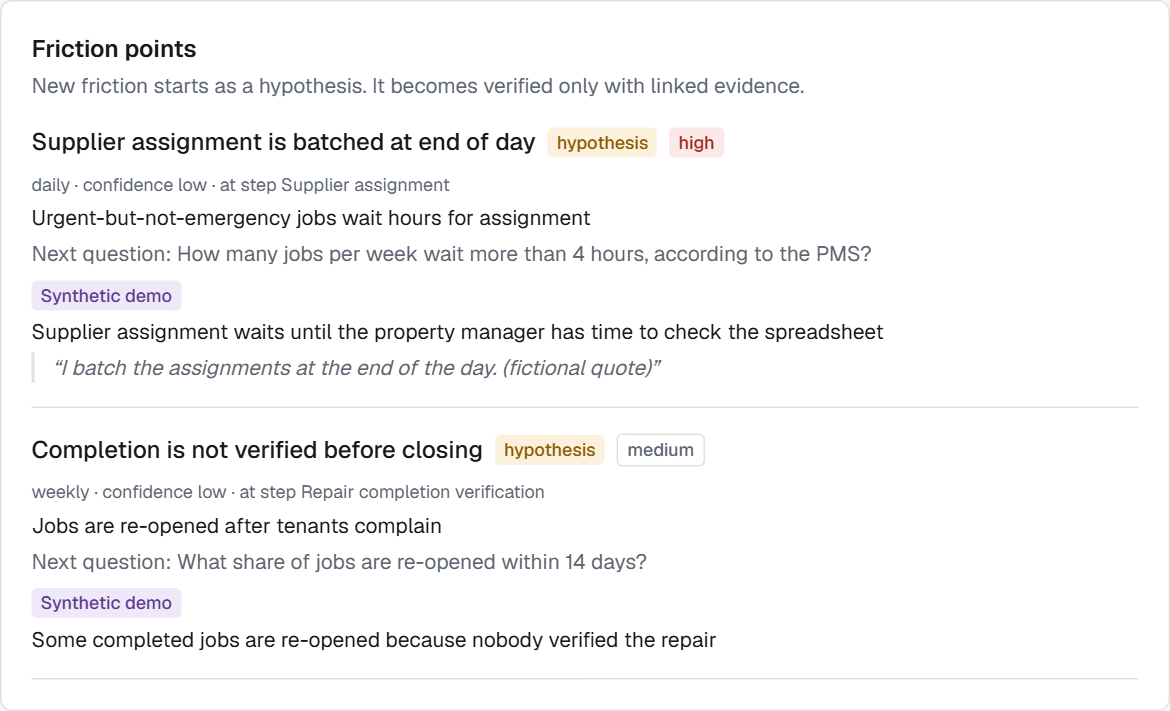
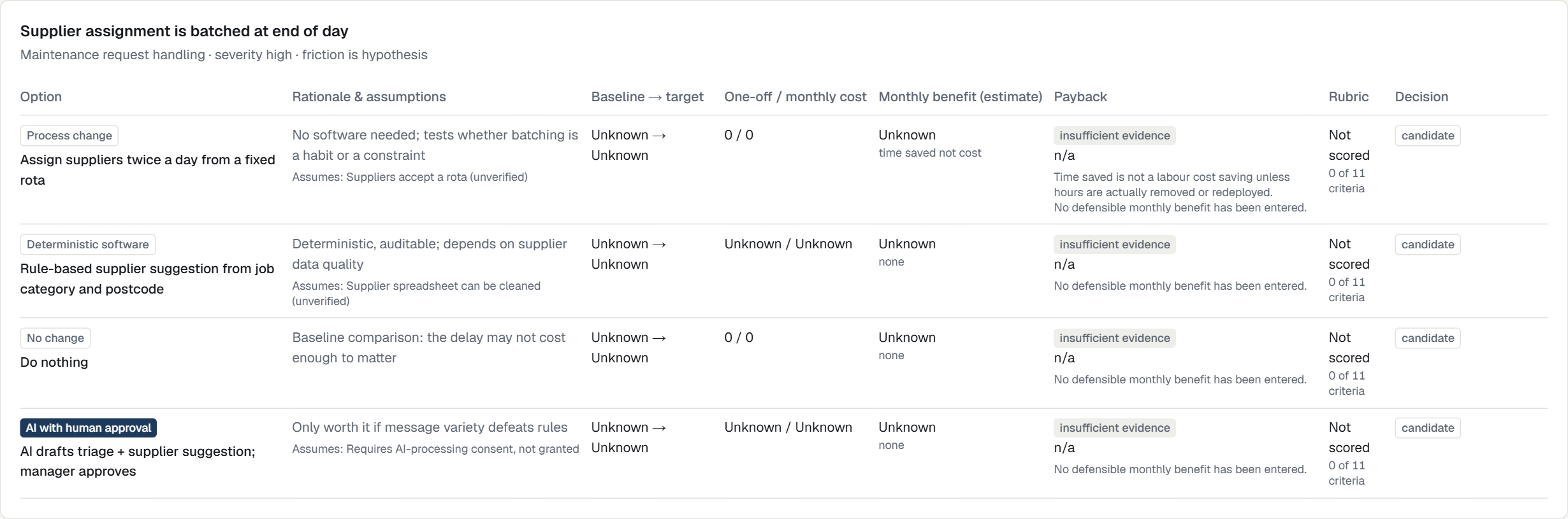
The work is supported by our own software. Every statement carries its source, every option is compared against simpler alternatives, and every result says how much it can be trusted.
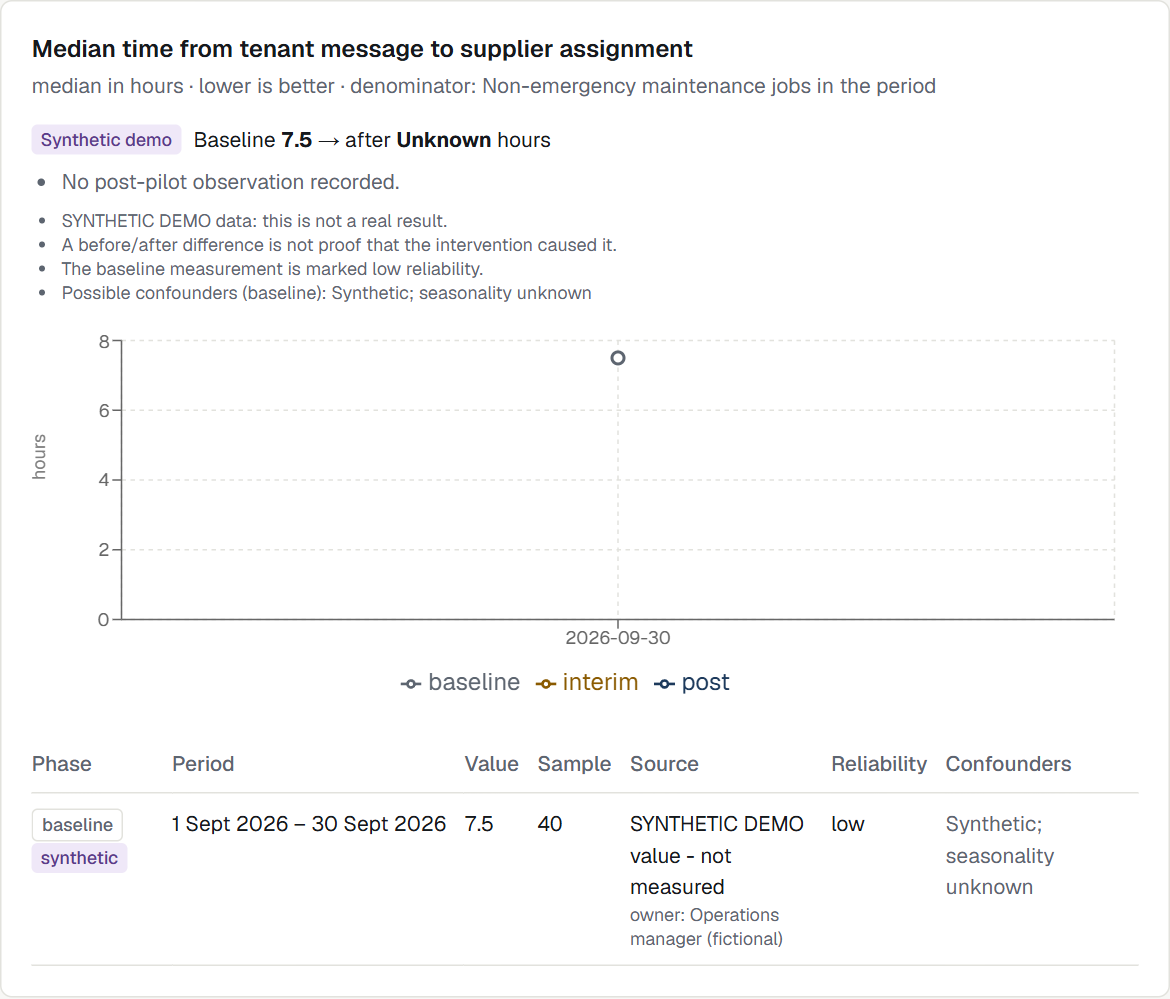
Every measure records its period, sample size, source and reliability. Missing values stay missing. A before-and-after difference is shown with its confounders, never as proof on its own.
How we work
We start with how the work is done today. Technology comes after we understand it.
A clearer process or ordinary software often beats AI. We compare them side by side.
Every finding records where it came from: observed, reported, a system record or an inference.
Sensitive pilots need a named approver who is not the person proposing them. Decisions are logged.
Changes are compared against a baseline, with the limits of that comparison stated.
We add a thin intelligence layer where it helps, not a replacement for tools that already work.
Illustrative scenarios, not customer implementations. Each starts with a handoff, a delay or a decision worth understanding.
A tenant reports a repair by phone, email or portal. A property manager triages it, finds a supplier, chases completion and updates the tenant.
Complaints arrive at the desk, by email and in reviews. Someone decides who handles each one and what compensation is appropriate.
First-line staff resolve what they can and escalate the rest, often by forwarding emails or messaging a colleague.
A deal closes and the operations team receives a summary, then rebuilds the details from emails and calls.
Who you work with
Founder, Ampassador · Embedded AI partner
Theodoros works directly with founders and operations leaders to turn a costly operating problem into a system their company owns — forward-deployed, not an agency. The work spans AI and automation systems, integrations and web products, along with technical mentoring for early AI founding teams.
Ampassador is early. You will work directly with the person who designs the method and builds the software — not with an account manager.
Questions
Both, and they are separate. The service is working with your team to study a workflow, compare fixes and run a measured pilot. The software is the workspace we use to keep that work structured: evidence, maps, baselines, approvals and reports. You can start a conversation about the service without signing up for anything.
No. We start from the tools you already use. Where something is missing, the first options considered are usually a process change or a small piece of software around your current systems, not a replacement.
No. AI is one option among several. Many workflow problems are better solved by a clearer process, a checklist or ordinary software. Every comparison includes those alternatives — and doing nothing.
An Operational X-Ray focuses on one workflow. We talk with the people who do the work, observe real cases, map the process, record a baseline and compare improvement options. It ends with a map, an evidence-backed list of bottlenecks and one scoped pilot proposal.
A pilot is one small change on a defined scope for a defined period. Before it starts it has a measure, acceptance criteria, stop conditions, a rollback plan and an approver who did not propose it. Afterwards we compare the result with the baseline.
Tell us where work slows down in your business. We will reply personally to arrange a conversation — no automated sequence, no obligation.